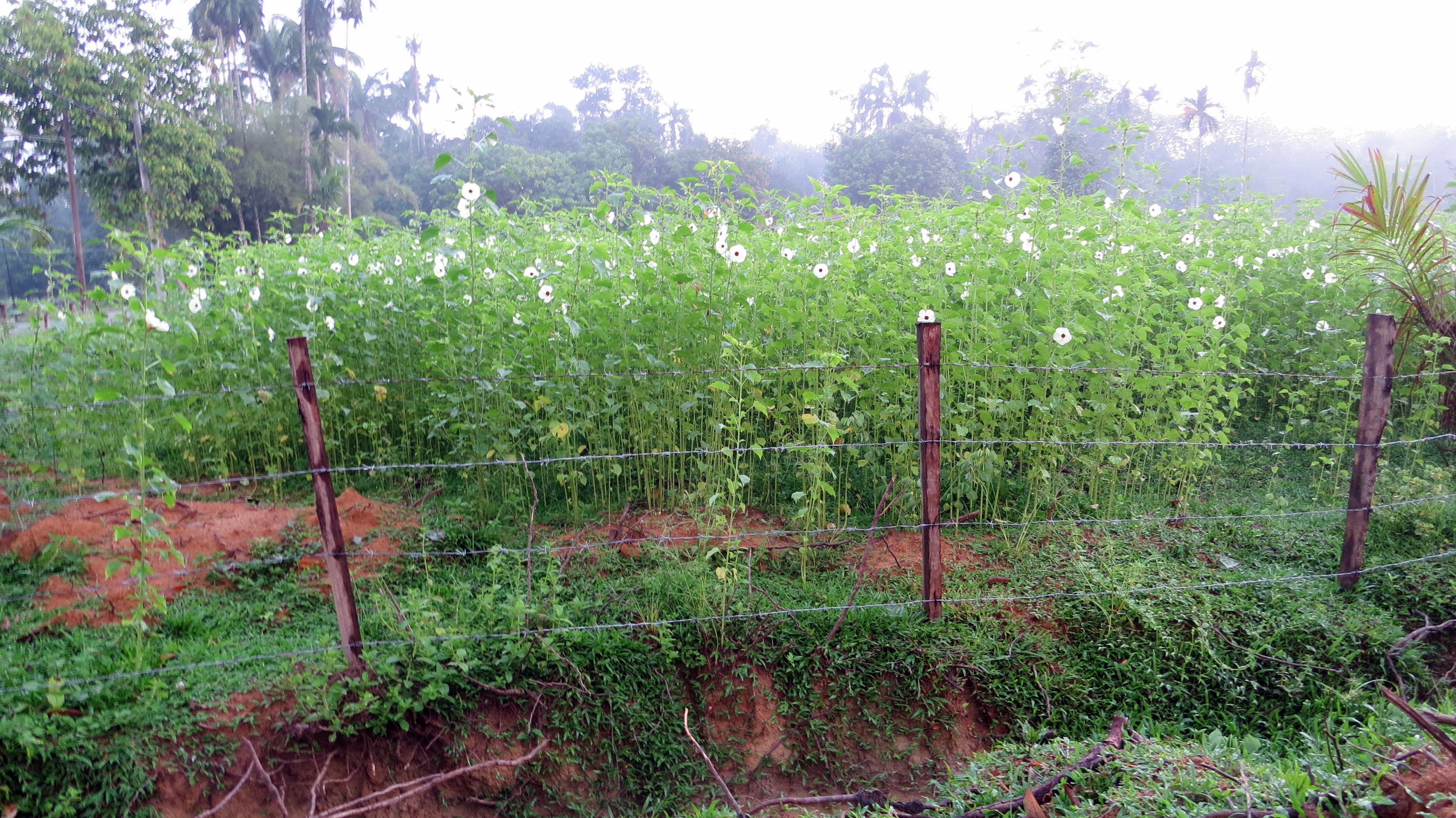
Kenaf: Agronomic Profile
Kenaf is a warm-season annual in the Malvaceae family, closely related to hibiscus and okra. It grows rapidly under appropriate conditions, reaching two to four meters in height within four to five months. The crop is adapted to subtropical and Mediterranean climates, making it agronomically feasible in parts of southern Italy, Spain, Greece, and Turkey.
The stalk of kenaf consists of two distinct fiber fractions:
- Bast fiber (outer bark): Long fibers with high tensile strength, cellulose content around 57 to 60 percent. Used in specialty paper grades, newsprint alternatives, and high-strength packaging applications.
- Core fiber (inner woody material): Short, coarser fibers with cellulose content of approximately 44 to 48 percent. Used in lower-grade paper and composites.
The bast-to-core ratio in kenaf stalks is typically 35 percent bast to 65 percent core by dry weight. Processing kenaf for paper requires mechanical separation of these two fractions before pulping, which adds a processing step compared to whole-stalk agricultural residues like bagasse.
Kenaf Pulp Properties
Kenaf bast fiber produces long-fiber pulp with characteristics approaching those of softwood kraft pulp in terms of tensile and tear strength. This makes it suitable for paper grades where mechanical performance is a priority. Kenaf core fiber produces short pulp more comparable to hardwood or agricultural residue pulps.
Research conducted in the 1990s at the USDA Forest Products Laboratory examined kenaf as a newsprint fiber alternative, finding that kenaf bast-core blended pulp could produce newsprint meeting industry specifications with lower chemical inputs than comparable wood-based newsprint pulp. These findings have been cited in subsequent European feasibility studies on kenaf cultivation.
Soda and kraft pulping are both used for kenaf. Soda pulping is more commonly reported in kenaf-specific operations due to lower capital requirements and suitability for smaller production volumes.
Kenaf in Italy
Experimental kenaf cultivation in Italy has been documented primarily in the regions of Campania, Puglia, and Sicily, where the climate is most compatible with the crop's heat and day-length requirements. Research institutions including the CREA (Consiglio per la Ricerca in Agricoltura e l'Analisi dell'Economia Agraria) have published field trial data on kenaf yields and fiber quality under Italian growing conditions.
Commercial-scale kenaf cultivation for paper fiber in Italy has not been sustained. A number of pilot projects in the 1990s and early 2000s did not transition to established commercial supply chains, primarily due to difficulties in establishing economically viable harvesting and retting infrastructure, and competition from imported non-wood pulps at lower cost.
As of available public documentation through early 2026, kenaf remains a technically documented but commercially marginal fiber source in the Italian context. The material appears in some Italian-produced specialty papers and in academic and policy discussions about domestic fiber crop diversification.
Hemp: Agronomic Profile and History in Italy
Hemp (Cannabis sativa L.) has a long cultivation history in Italy. The Po Valley, particularly the provinces of Ferrara, Bologna, and Rovigo, was a major European hemp production center from the medieval period through the early 20th century. Italian hemp rope was a standard material for maritime rigging across Mediterranean navies.
Cultivation declined sharply through the mid-20th century due to a combination of synthetic fiber competition and regulatory restrictions following the 1961 UN Single Convention on Narcotic Drugs, which treated all Cannabis sativa varieties as controlled substances regardless of psychoactive content.
Italian cultivation resumed legally following Law 242 of 2016, which established a framework for cultivation of low-THC hemp varieties (below 0.2% THC by dry weight) for industrial and agri-food purposes. EU Common Agricultural Policy rules also govern hemp cultivation under specific conditions tied to approved variety lists published by the European Commission.
Hemp Fiber Characteristics for Paper
Hemp bast fiber is among the longest natural fibers used in papermaking, with reported lengths of 5 to 55 mm depending on retting and processing method. This distinguishes it significantly from both bamboo and bagasse fibers. Hemp paper made primarily from bast fiber has documented durability characteristics that account for its historic use in currency paper, cigarette paper, and archival documents.
| Fraction | Fiber Length | Cellulose | Lignin | Application |
|---|---|---|---|---|
| Hemp bast | 5–55 mm | 55–77% | 2–5% | Specialty, currency, filter paper |
| Hemp hurds (core) | 0.5–1.5 mm | 40–48% | 22–28% | Packaging board, composites |
| Kenaf bast | 2–6 mm | 57–60% | 8–13% | Newsprint, kraft packaging |
| Kenaf core | 0.4–1.0 mm | 44–48% | 15–21% | Filler grades, composites |
Hemp hurds (the inner woody core material) are a lower-value co-product of bast fiber separation. They are used in paper and board applications where long fiber length is less critical, as well as in animal bedding, construction materials, and as a growing medium in horticulture.
EU Regulatory Context
Hemp cultivation in EU member states, including Italy, requires use of varieties listed in the EU Common Catalogue of Varieties of Agricultural Plant Species, with a THC content threshold (currently 0.3% as revised in 2023 common agricultural policy regulations). Cultivation requires notification to relevant national agricultural authorities.
Kenaf faces no analogous regulatory restrictions and can be grown under standard agricultural frameworks. However, the absence of established kenaf seed supply networks and specialist harvesting equipment in Italy limits practical cultivation.